Overview
- Over 80 auto auctions are held every week in Japan, with more than 140,000 vehicles offered for sale.
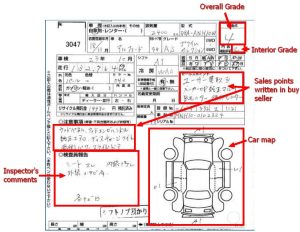
- This guide explains how to read Japanese auction sheets—an essential skill for anyone considering importing a vehicle.
- The company has over 25 years of experience sourcing vehicles directly from Japan for private buyers in Australia, inspecting cars weekly at major auction centers such as Tokyo, Nagoya, Osaka, Kobe, and Fukuoka.
How to Read an Auction Sheet
1. Overall Grade & Interior Grade
2. Symbols & Abbreviations
- Common option codes:
- SR = sunroof
- AW = alloy wheels
- PW = power windows
- AB = airbag.
- The vehicle diagram shows scratches, dents, and repaired areas:
XX – Panel Replacement / Repaint
Indicates a panel has been replaced or refinished.
“W” marks show uneven or non-factory-smooth paint. Sometimes the difference is barely visible, and auction inspectors may label a panel “W” when unsure. W1–W3 reflect increasing levels of unevenness.
A – Scratches
A1 = very fine scratch that can typically be polished out.
A2 = noticeable scratch through the paint layer that won’t be easily concealed.
A3 = deep gouge or heavy scraping that will require repainting to correct.
U – Small Dents (Pin Dents)
Minor car-park-type dents.
U1–U4 indicate dent size, with 1 being the smallest.
B – Larger Dents
More significant dents than U-grade marks, clearly visible. Graded B1–B4.
G – Chips
Often seen on windscreens or panels. These usually refer to small stone chips or tiny marks—normal wear that doesn’t generally require replacement.
Y – Cracks
Y1–Y4. Typically found in body kits or light housings. Often minor and easy to repair or replace.
P – Paint Defects
P1–P4 note issues like fading, scratches, discoloration, peeling, crazing, or poor previous paintwork.
S / C – Rust or Corrosion
S or C1 can indicate small surface rust, such as on a stone chip or sunroof edge.
But when listed in the negative remarks section, “S” may point to major underbody rust.
“C” on wheel arches usually signals serious corrosion from snow-region use.
Even high-grade cars (e.g., 4.5) can have rust, so physical inspection is always performed regardless of auction notes.
3. Choosing Auctions & Regions
- The most reliable auctions—with the best selection and consistent quality—are located in major cities such as Tokyo, Nagoya, Osaka, Kobe, and Fukuoka.
- Regions like Hokkaido/Sapporo, which experience heavy snow and road salt, pose a higher rust risk and are generally avoided.
To avoid cars repeatedly circulated for resale, the company prioritizes first-time listings and high-grade vehicles.
Company’s Policy When Selecting Vehicles
-
They do not rely solely on auction grades; they inspect vehicles in person, checking the engine, transmission, underbody, interior/exterior condition, options, and any signs of repair.
-
They review past auction history and repair records using third-party databases (e.g., Japan Car History Check) to avoid repeatedly listed or previously repaired vehicles.
-
For cars under recall in Japan, they arrange for recall repairs to be completed before export, ensuring compliance with Australian import regulations such as SEVS.
Quick Summary
- By understanding auction grades, symbols, and abbreviations, buyers can get a good picture of a vehicle’s condition, repair history, and equipment.
- However, grades alone are not enough—physical inspection, history verification, and checking for rust or previous repairs are essential.
- To secure a high-quality import, focus on first-time listings, high-grade vehicles, rust-free regions, and thoroughly inspected cars.